

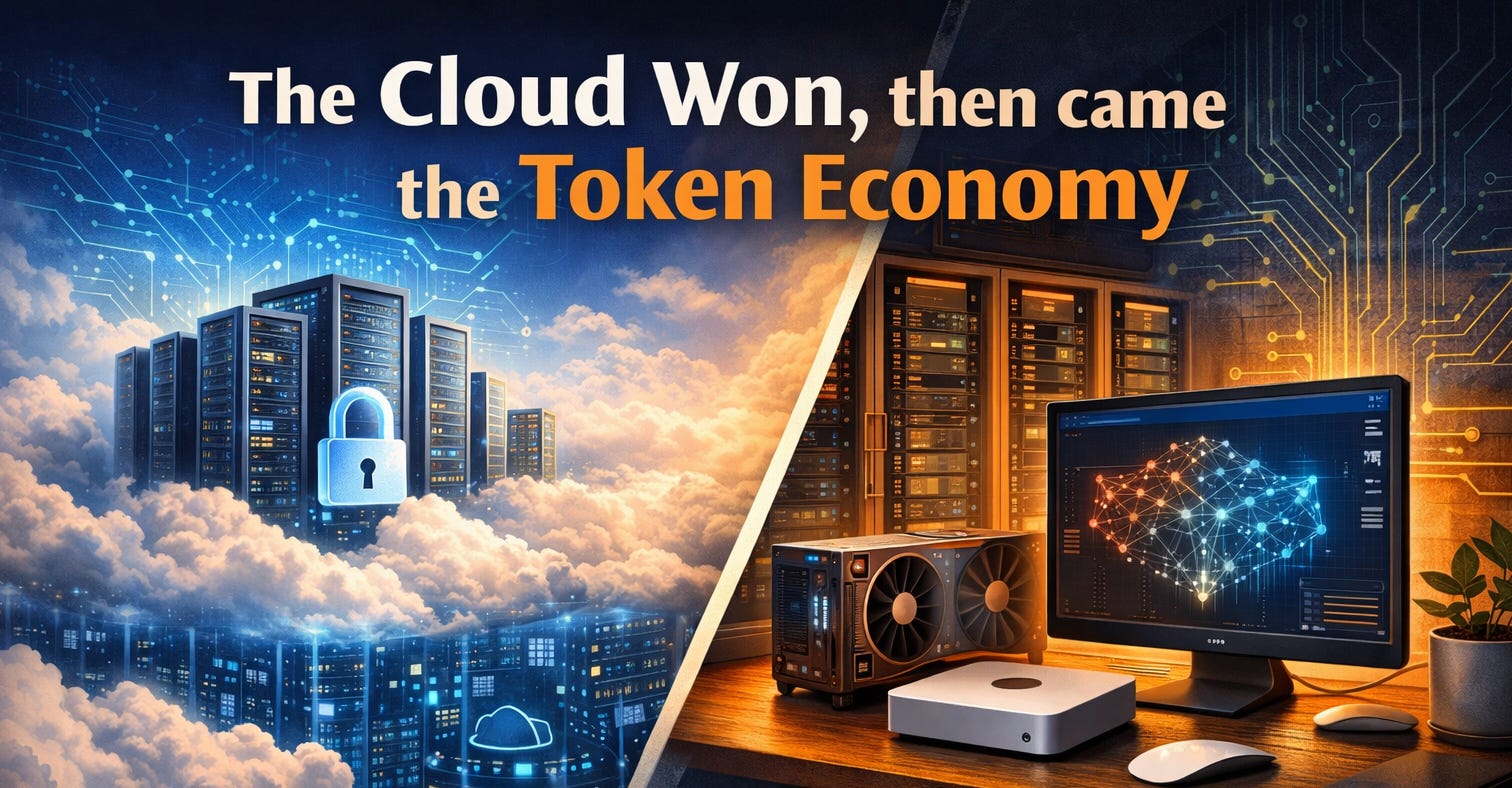
I spent years arguing with the people who never wanted to let go of their servers. You know the type. In every cloud migration, they had a reason a workload couldn’t move: security, latency, data residency, compliance, or some special dependency that somehow made their rack of aging hardware sacred. A lot of it boiled down to one instinct: they trusted what they could see with their own eyes. I had very little patience for that mindset. My view was simple: if a workload still needed local hardware, that usually meant the cloud hadn’t solved the problem yet. Give it time. The economics would win. For a long time, they did. Then AI changed the math.
AI introduced a new bottleneck: TOKENS
What I didn’t fully appreciate was that the next era of computing wouldn’t just be about storage, networking, or compute. It would be about access.
If you use frontier AI models heavily, you already know the feeling. Yes, the cost can add up. But the bigger frustration is often the rate limits, throttling, usage tiers, queueing, and the constant sense that someone else controls how much you’re allowed to do. I kept running into the same problem. I am not compute constrained. I am token constrained.
That matters because the standard model of pay per token, accept the limits, and keep swiping the card doesn’t feel great once AI becomes part of your daily workflow. When a pricing model starts to pinch, people look for another path. That is exactly what is happening now.
The escape hatch is local inference
That alternative is increasingly sitting on a desk. For many consumers and builders, it looks like a Mac mini. When Apple began designing its own chips, the story was battery life, thermal efficiency, and tighter integration. Almost nobody was talking about local AI inference. But Apple Silicon ended up with a feature that matters enormously for running language models, unified memory. Because the CPU and GPU share the same memory pool, these machines can run models locally in a way that feels surprisingly practical. A Mac mini with enough memory can run models like Qwen or DeepSeek through tools such as LM Studio or Ollama, with effectively zero marginal per-token cost after you buy the machine. No API billing. No rate limits. No cooldown timer. No provider decides you’ve had enough for the hour.
That does not mean local is always better. It is not. Cloud APIs still win when you need the very best frontier models, massive parallel scale, or a fully managed platform. But for many everyday use cases of summarization, coding help, extraction, drafting, classification, translation, private internal workflows, local inference is now good enough to be economically compelling. And once “good enough” gets paired with predictable cost, people pay attention.
The same economic logic is showing up everywhere
The shift is not just happening at the hobbyist level. For heavier inference workloads, teams are already stitching together multiple machines into a small local cluster. What used to sound eccentric now sounds practical. Buy compute once, run models locally, and stop paying a toll every time someone asks a question. That is also the logic at play in hyperscale.
When Jensen Huang said the future was accelerated computing, he was right. What many people missed was the second order effect. Once AI becomes foundational, nobody wants to depend entirely on rented access forever.
The world’s largest technology companies are responding accordingly. They are not just buying GPUs. They are designing their own silicon, building new datacenter capacity, and trying to control more of the stack. That is the clearest signal in the market.
NVIDIA is winning, but its customers are learning the lesson
NVIDIA remains the standard. Its hardware is exceptional, and its position is still incredibly strong. But when your annual AI infrastructure bill reaches into the billions, the same old economic conclusion starts to emerge: own more, rent less. Google has TPUs. Amazon built Trainium and Inferentia. Microsoft has Maia. Meta is investing in custom silicon. Apple has spent years perfecting its own approach to consumer hardware. That does not mean NVIDIA is in trouble tomorrow. It means the biggest buyers in the market are doing what big buyers always do when a supplier becomes too central to their cost structure. They seek leverage, alternatives, and vertical integration. That same instinct is now appearing at the individual level. The hyperscalers are solving it at a datacenter scale. Developers and small teams are solving it at the desk scale. Different budget. Same math.
Open-weight models from China deserve to be taken seriously
This is where some readers will disagree, but it is increasingly hard to ignore. Models such as Qwen, DeepSeek, and Kimi are better than many people assume. Not just “good for open source” or “good for the price.” In many practical workflows, they are simply good. No, they do not beat the very best proprietary models at everything. But the gap is narrower than many people think. For many business use cases, it is narrow enough that cost, privacy, and control become more important than absolute benchmark leadership. That is a meaningful shift. Much of the skepticism toward these models stems from valid concerns which are always governance, trust, and geopolitics. Those issues matter. But some of the dismissals are just reflexes from people who have not seriously tested the models in real workflows.
That reaction reminds me of the old resistance to cloud migration. Different technology, same pattern. People form strong opinions before they touch the tool. The broader point is not that every open-weight model is equal to Claude or ChatGPT. It is that model parity is arriving faster than many expected for a large share of business tasks. And when one option costs real money every time you use it, while another runs locally on hardware you already own, the economics start to matter a lot.
Apple’s accidental AI advantage
This might be the strangest twist in the whole story. Apple did not build Apple Silicon for the AI inference market. It built Apple Silicon to improve control, efficiency, and product performance. But that architecture turned out to be unusually well-suited to local AI. The same design choice that makes a Mac feel fast and efficient in normal use also makes it credible as a local inference machine. That is a strategic advantage Apple may not have fully intended, but it now benefits from all the same.
NVIDIA sees this opportunity too. Products like DGX Spark point in that direction. But for most individuals and smaller teams, Apple’s advantage is simple: its machines are available, familiar, and comparatively affordable.
That is why so many local AI experiments are happening on Mac Minis and Mac Studios. They are not perfect. They are not universal. But they are accessible, and accessibility matters more than elegance when a market is forming.
Projects like OpenClaw are a good example of where this is heading. Autonomous agents running locally on Apple hardware, with responsive inference, more privacy, and no per-token billing loop in the middle. Whether Apple planned that outcome or stumbled into it is almost beside the point. Strategic bets often pay off in unexpected ways. This is one of them.
The cloud is not dead. But AI is pulling some workloads back
So where does that leave us? The cloud still won the last era. It solved real problems, reliability, elasticity, managed services, global reach, and operational simplicity. None of that disappears because local inference got better. But AI introduced a new friction point. For many users, the bottleneck is no longer compute capacity. It is metered access to intelligence. That is why hardware is back in the conversation. Not because people suddenly miss blinking lights and server rooms. Not because on-prem is inherently superior. But because tokenized access changes behavior. When the toll booth becomes too expensive, people start looking for another road. That dynamic will likely accelerate the market for smaller, more efficient models designed for prosumer and enterprise edge hardware. For many workflows, tiny models running locally are not a toy. They are becoming the practical default. In that sense, the old server loyalists were wrong about the reason hardware mattered. But they may have been early in noticing that, sooner or later, ownership has a way of coming back.
What this means in practice
If you are spending meaningful money on API tokens, do the math. Compare your monthly usage against the one-time cost of local hardware. Look at where you truly need frontier performance and where you only need a capable, private, always-available model. The breakeven point may be closer than you think. If you have never tried local inference, start small. Run a good open-weight model on a machine you already own. Test real workflows, not just benchmarks. Pay attention to cost, latency, privacy, and how it feels to build without a meter running in the background. And if you lead a business, do not frame this as cloud versus on-prem. That is the wrong debate. The real question is which AI workloads you should keep renting, and which ones are now worth owning. That answer is going to reshape many technology decisions over the next few years.